



The best way to clean a garbage disposal is to follow the manufacturer’s instructions, clean only safely accessible components, and prevent grease and excessive food waste from entering the unit in the first place.
That becomes especially important around Thanksgiving, when turkey scraps, cooking oils, potato peels, vegetable trimmings, and a sink full of dishes can create a much heavier workload than usual.
A garbage disposal can process appropriate small food scraps. It should not be treated as a substitute for the trash, food-waste collection, or composting where those options are available.
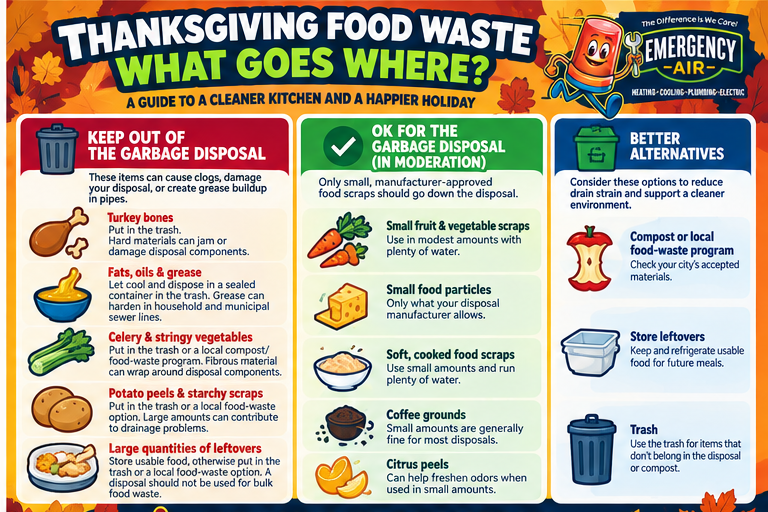
What Thanksgiving Foods Should Stay Out of the Garbage Disposal?
Some of the foods most likely to end up in the sink during Thanksgiving cleanup are exactly the materials that deserve another disposal method.
Why Should Fats, Oils, and Grease Stay Out of the Drain?
Turkey drippings, cooking oil, gravy grease, butter, and other fats should not be washed into the sink just because they are liquid while hot.
As these materials cool, they can congeal and accumulate inside pipes.
The City of Phoenix specifically advises residents to keep fats, oils, and grease out of sinks and garbage disposals.
A better Thanksgiving cleanup routine is:
- Let grease cool.
- Pour or scrape it into an appropriate container.
- Dispose of it according to local waste guidance.
- Scrape and wipe greasy cookware before washing it.
Running hot water after grease does not make the problem disappear.
Can You Put Turkey Scraps and Leftovers Down the Disposal?
A garbage disposal is not intended to process an entire Thanksgiving plate.
Keep turkey bones, large food scraps, grease, and large quantities of leftovers out.
Even when a disposal can grind a particular food, the resulting particles still enter the household drain and wastewater system.
Instead:
- Store usable leftovers promptly.
- Scrape plates before rinsing them.
- Use a sink strainer where appropriate.
- Use trash or locally accepted food-waste programs for larger scraps.
- Check your municipality’s rules before assuming plant scraps can go in a curbside compost container.
Programs vary across Phoenix, Chandler, Mesa, Gilbert, Scottsdale, Tempe, Glendale, and neighboring communities.
Is Composting Better Than Using a Garbage Disposal?
There is no single answer for every household.
The environmental effect depends on the local wastewater system, food-waste collection options, transportation, treatment methods, and what type of food is being discarded.
The most useful hierarchy is:
Prevent edible food waste first.
Plan portions realistically and store leftovers safely.
Use an available food-waste program when appropriate.
Follow the provider’s accepted-material rules.
Use the trash when necessary.
That is still preferable to putting grease, bones, or inappropriate scraps into household plumbing.
Use the disposal for appropriate small scraps.
Follow the manufacturer’s instructions.
Avoid claiming that every scrap must be composted or that everything processed by a disposal disappears harmlessly.
What Is the Best Way to Clean a Garbage Disposal?
For routine cleaning, start with the disposal manufacturer’s instructions.
The goal is to remove ordinary residue without exposing yourself to moving components or using chemicals that may not be compatible with the unit.
Turn Off Power Before Cleaning Accessible Components
If you need to clean a removable splash guard or another component near the opening, prevent the disposal from accidentally starting according to its manufacturer’s instructions.
Never put your hand inside an operating disposal.
If you do not know how to safely isolate power, stop and leave the task to a professional.
Clean the Sink Opening and Accessible Splash Guard
Food residue can collect around the sink opening and accessible portions of the rubber splash guard.
Use a mild cleaning method that is compatible with the equipment.
You do not need to dismantle the disposal to address ordinary residue.
Operate the Disposal Only as Directed
Garbage disposals generally require water during operation.
Do not try to conserve water by running a disposal dry if the manufacturer requires flowing water.
Use only as much runtime and water as necessary under the operating instructions.
What Is the Best Garbage Disposal Cleaner?
There is no universally best commercial product.
A useful order of preference is:
- Manufacturer-approved routine cleaning
- Mild cleaning products compatible with the unit
- Specialized garbage-disposal cleaners specifically permitted for the equipment
Do not assume a harsher chemical is more effective.
Before using any cleaner, check both the disposal instructions and the product label.
Can Baking Soda and Vinegar Clean a Garbage Disposal?
Baking soda and vinegar may help with ordinary surface cleaning in some circumstances, but the fizzing reaction should not be mistaken for proof that a clog, grease buildup, or deep internal residue has been removed.
It is not a substitute for professional drain cleaning.
More importantly, do not combine vinegar, bleach, drain cleaner, or other household chemicals.
Mixing cleaning agents can create dangerous reactions or fumes.
Should You Pour Bleach or Drain Cleaner Into a Disposal?
Avoid pouring strong chemicals into a disposal simply because the sink smells or drains slowly.
First check whether the product is approved for the equipment and plumbing.
Persistent drainage problems may require professional drain cleaning rather than another cleaning product.
Adding harsh chemicals before professional drain work can also create unnecessary exposure concerns.
Why Does My Garbage Disposal Smell Bad?
Food residue around the disposal, splash guard, or drain can produce odors.
Routine cleaning may help when the problem is limited to accessible buildup.
A persistent smell deserves more attention when it occurs with:
- Slow drainage
- Recurring clogs
- Water backing up
- Leaks beneath the sink
- Humming without normal grinding
- Unusual mechanical noises
- A unit that repeatedly needs resetting
Emergency Air offers garbage disposal repair and installation when routine cleaning does not correct the problem.
How Can You Prevent a Thanksgiving Garbage Disposal Clog?
Prevention starts before the dishes enter the sink.
During holiday cleanup:
- Scrape plates into the trash first.
- Keep bones out.
- Collect grease separately.
- Wipe oily pots and pans before washing.
- Keep stringy vegetables and excessive peels out.
- Use a sink strainer where appropriate.
- Feed appropriate scraps gradually rather than all at once.
- Operate the disposal with the amount of water specified by the manufacturer.
Phoenix Water Services recommends using dry cleanup before wet cleanup—scraping and wiping first, then washing.
That is good kitchen-plumbing advice whether or not your home has a disposal.
When Should You Call a Plumber for a Garbage Disposal?
Call for professional help when the problem moves beyond ordinary cleaning.
Examples include:
- Persistent odors after normal cleaning
- Recurring sink clogs
- A disposal that hums but does not operate normally
- Grinding or clanking sounds
- Water leaking from the disposal or connections
- Frequent resets
- Electrical concerns
- A sink that remains slow after basic care
Do not reach inside to remove an obstruction.
Emergency Air also provides broader Phoenix-area plumbing services when the problem turns out to involve the kitchen drain rather than the disposal itself.
FAQs
What is the best way to clean a garbage disposal naturally?
Use a mild cleaning method permitted by the manufacturer and focus on safely accessible surfaces. “Natural” does not automatically mean that a substance is safe or effective for every disposal.
Can I put turkey bones in the garbage disposal?
No. Turkey bones and other hard materials should go in the trash rather than through the disposal.
Does a garbage disposal get rid of grease?
No. It does not prevent fats, oils, and grease from entering the drain and sewer system.
Why is my garbage disposal humming?
Humming without normal operation may indicate a jam or mechanical problem. Do not put your hand inside the disposal or dismantle it. Follow the manufacturer’s safe troubleshooting instructions or call a plumber.
Can I compost Thanksgiving food scraps in Phoenix?
Possibly, depending on your municipality or private provider. Food-waste and composting programs vary throughout the Phoenix metro area, so check local accepted-material rules first.
Keep Thanksgiving Cleanup From Turning Into a Plumbing Problem
If your disposal has persistent odors, recurring clogs, leaks, or mechanical problems, contact Emergency Air Heating Cooling & Plumbing for professional garbage disposal or kitchen plumbing service in the Phoenix metro area.
